Author: admin

  • Blog Post #5: Creative Project

    Blog Post #5: Creative Project

    Nutrition is one of the most essential aspects of living a healthy life yet so much of the content online surrounding this topic is either misinformed, reactionary or exaggerated. As someone who recently got into a gym routine, my social media feed is full of weightlifters, doctors and nutritionists who make claims about the food that most of us on a daily basis, and parsing between the weeds can get difficult, especially for a novice. This 2023 systematic review of 64 studies from the National Institute of Health (NIH)stated that half of the reviewed studies found that nutrition information on social media was “suboptimal” and “one of the biggest limitations of using social media for this purpose (nutrition) was the lack of quality and reliability of health information”, while also acknowledging the limitations of the review because of biases like inconsistent sampling and accuracy checks across each and every individual study.

    The audience I’m targeting through this blog post are people like me, who had a very limited knowledge of nutrition and diet but want to learn about it to implement changes in their daily life. Within this post, I want to teach my audience how to utilize the SIFT method to cross-reference misinformation, and I’ll be doing so through a few examples. I will also talk about creators and websites that I have found to be reliable based on my own experience using this method. I personally like the SIFT method because it gives me a process that I can go through without constricting how to view the content, and allows me to make my judgement based on a few important factors.

    First off, I want to begin with the SIFT method itself which follows a simple structure:

    S: Stop (and think about your emotional response)

    I: Investigate the Source

    F: Find Better Coverage

    T: Trace Claims and Quotes to their original content

    Like I said, this gives us a process of acknowledging our own emotional response, looking at the source of information, looking for other sources to see if they corroborate the information and then tracing the original claims made in the video.

    Let’s take a look at an example that this method could be used for.

    Example #1

    If you’re on nutrition social media long enough, these type of videos show up often, demonizing certain food groups. Using the SIFT method, let’s go through the videos. The first video makes a number of claims about kale while in a super market, including that it’s “garbage” and “doesn’t want to be eaten”, and the second furthers that statement, saying that “plants don’t want to be eaten”.

    S: For most, including myself, my immediate reaction was to be skeptical of the claims. Kale, at least from my experiences, is generally considered a “healthy food” and I would be curious to see what evidence the creator provided for this.

    I: From the creator’s profile itself, we can see that he’s an independent “double board certified MD” named Paul Saladino. He also has links to his own website in his bio, where he employs a quiz and later a monetized meal plan for interested individuals. A little bit of research through Google also reveals that Saladino founded/co-founded two animal-based food and supplement brands – Lineage Provisions, and Heart and Soil. Saladino also toggled between a carnivore and animal-based diet, as noted in this New York Times article, and is the author of “The Carnivore Code”. The NYT piece goes on to quote “blue zone” author Dan Buettner that he knows of “no long-lived culture in the history of the world that were mainly meat eaters”, and also refers to a 2023 New Yorker article, which notes that “studies of Neanderthals have turned up evidence that their diets included dates, tubers and other leafy foods in addition to meat.”

    Saladino’s views appear to have a very clear bias, in terms of his personal lifestyle and business goals, that could affect his portrayal of the information. Looking up what other experts in this field or the general information coming from larger medical boards is an easy way to utilize the SIFT method here.

    F: Most major studies appear to be against this claim. Google is one way to look it up but published studies on PubMed are a great way to scientifically verify the correct information.
    This 2017 meta-analysis published in the International Journal of Epidemiology, a reputed medical journal published by Oxford University Press, observed 95 different studies from 142 publications, and found that there was an associate risk in terms of an increase in fruit and vegetable consumption, and the intakes “were associated with reduced risk of cardiovascular disease, cancer and all-cause mortality.”

    This would be one source to choose from; as mentioned earlier, the NYT and New Yorker articles both referred to other biologists, rat studies and Neanderthal findings to refute the first point as well. While studies almost always have limitations, through confounding factors of the participants, a general consensus, such as the one shown in this study conducted over a number of years, clearly lands on one side. Saladino’s videos also don’t mention a key aspect of nutrition, which is it’s individuality. Each person has a different reaction to foods, and a one-size-fits-all approach is never recommended.
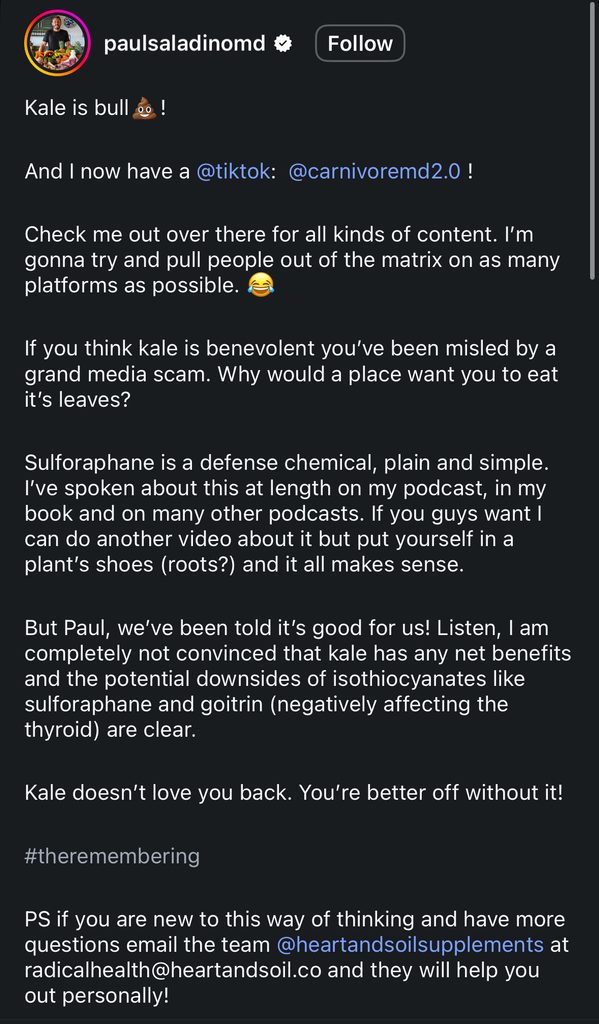
    Saladino appeals to emotion through this description, providing no links to studies or sources and using sensitive words like “scam”, “misled” and “matrix”.
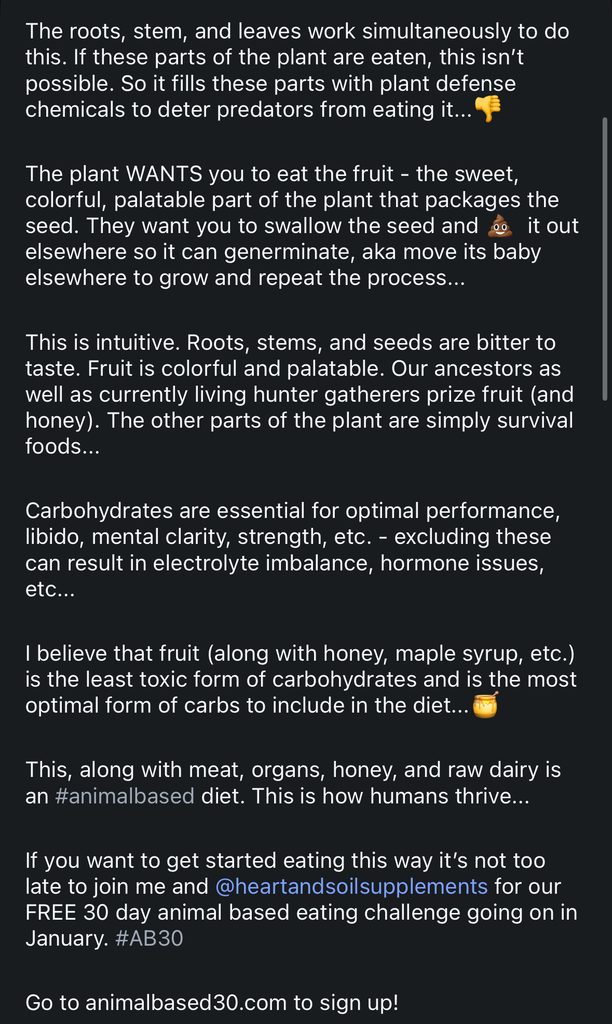
    Saladino once again doesn’t refer to any outside sources, talks in vague claims with his own beliefs and plugs his own company at the end.

    The American Board of Medical Specialists stated as such in this statement, supporting the view that it is their “fundamental premise that all medical care should represent a shared decision agreed upon between a patient/guardian and a health care provider.”

    T: Here comes a part of the video that could be difficult to administer within the SIFT method. Saladino doesn’t refer to any study or article within the video or within the description. Instead, he states that he’s spoken about the defense chemical sulforaphane on his “podcast, in (his) book and on many other podcasts” (shown in Image 1 above). Cross-referencing his claims therefore becomes almost impossible since his claims boil down to anecdotal or purely biological assertions. In this scenario, the F part of the method becomes even more important.

    Example #2

    Now let’s take a look at an example that I think does a better job of being open to the method, and providing more evidence-based information. This Instagram reel is a little different than the first one, since the creator here is responding to a claim made rather than making one herself but the difference in presentation is apparent.

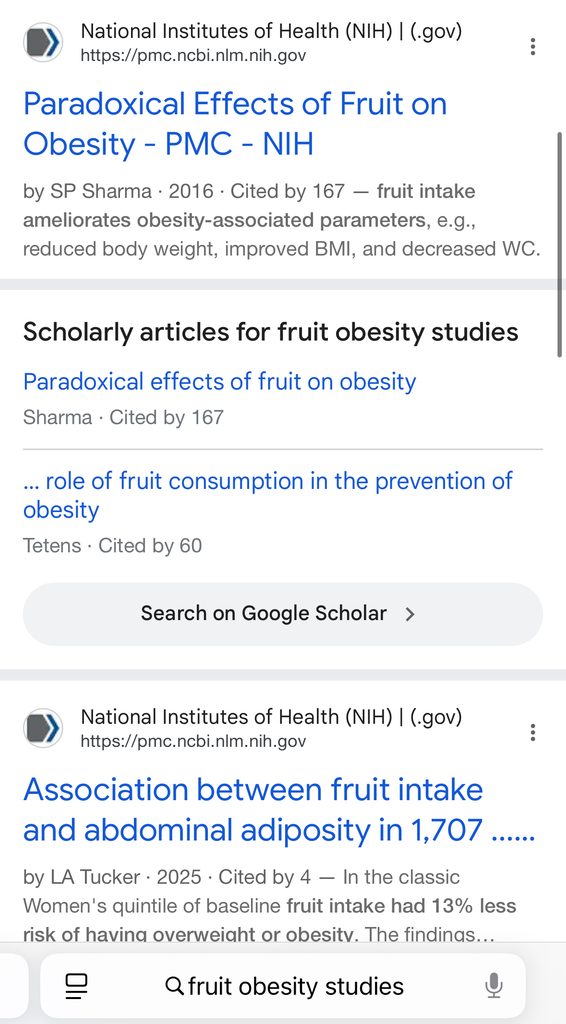
    S: This information aligned more with what I generally knew in regards to fruit consumption in that it was healthy. For a young person trying to figure out a healthy diet, the claim fruit makes you fat could easily be used to eliminate that category from your daily intake. Therefore, researching this claim could be extremely helpful.

    I: From her website, the creator is Dr. Jessica Knurick, a “Registered Dietitian with a PhD in nutrition science.” While Saladino has had a number of major organizations, medically and journalistically, speak out against his claims, Knurick doesn’t have many. Interviews with Trevor Noah, NPR and other podcasts make up the bulk of her online presence outside of her informational content so in this case, it would be a little difficult to gain an outside source’s perspective on her. However, cross-referencing her citations could work as a way of fact-checking her.

    F: One way to utilize the SIFT method is to look for organizations who might disagree with the original content and see if their evidence aligns themselves with the claim or not.

    Despite often being critical of HHS’ polices, Knurick’s claim here is supported by them. In the Scientific Foundation for the Dietary Guidelines for Americans from the HHS Realfood.gov website, HHS states that “RCTs demonstrate beneficial cardiometabolic effects of minimally processed carbohydrate-rich foods, such as intact fruits, vegetables, and whole grains”, also noting that higher dietary fiber, which fruits often have, was “associated with lower risk of all-cause mortality (17%, Moderate certainty evidence), colorectal cancer (16%, Moderate certainty evidence), type 2 diabetes (8%, Moderate certainty evidence), and coronary heart disease (20%, Low certainty evidence).”

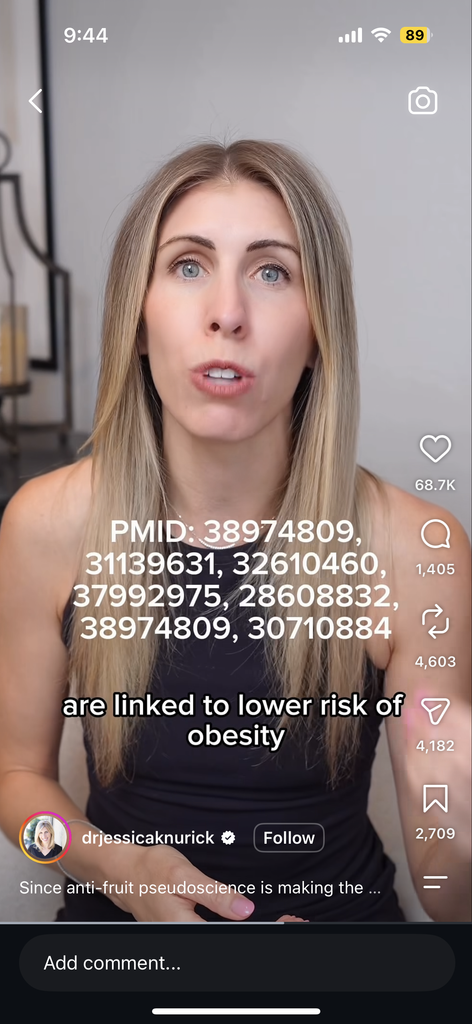
    T: As shown throughout her video, Knurick makes it easy for a viewer to cross-reference her, providing the names of studies on screen, as well as PubMed Identification Numbers (PMID). This makes it extremely easy to administer the “T” in SIFT and verify if the number she used are falsified or not.
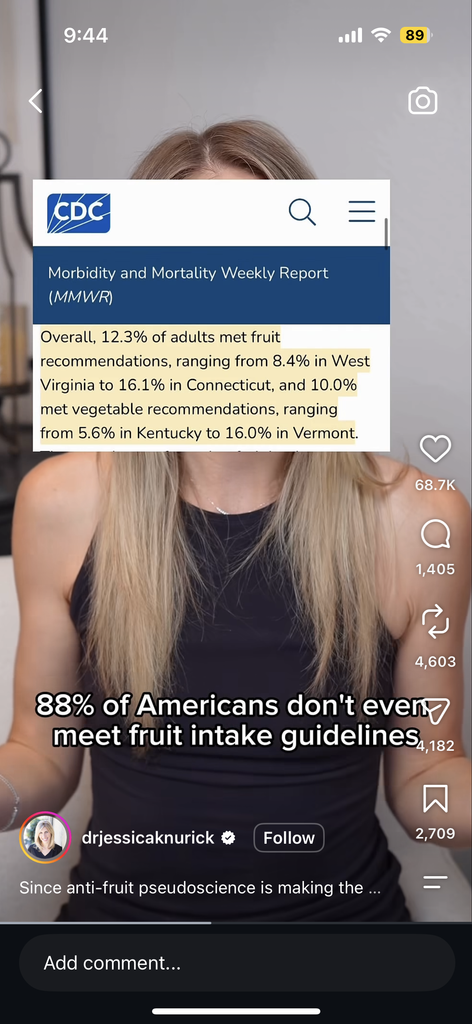
    Knurick clearly shows a study that can be checked with specific numbers to back up her claim.
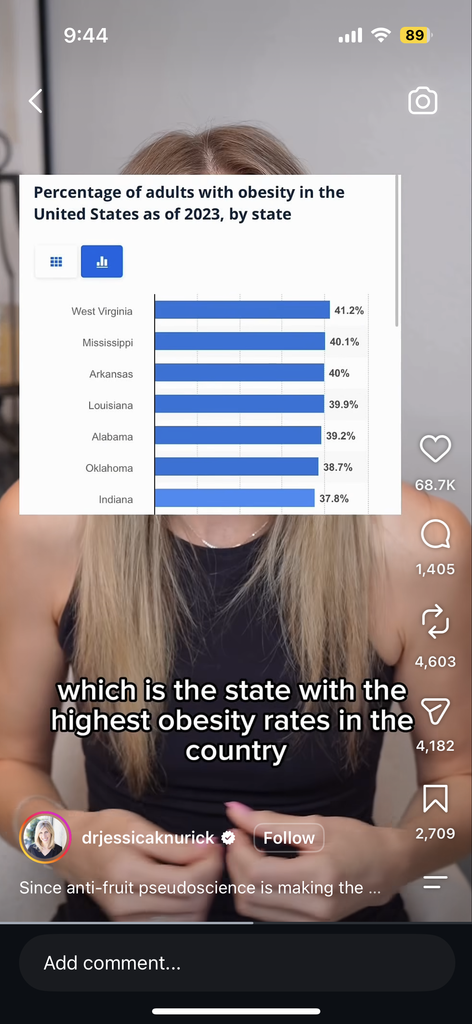
    Here, she backs up her previous claim showing a lack of correlation between obesity rates and eating fruit.
    Finally, she links to a number of studies that test this phenomena rather than just leaving with associate studies.

    For example, we can easily look up something as simple as “CDC, 12.3% of adults, fruit” and confirm that the screenshot from the CDC’s own website in January 2022 is correct.
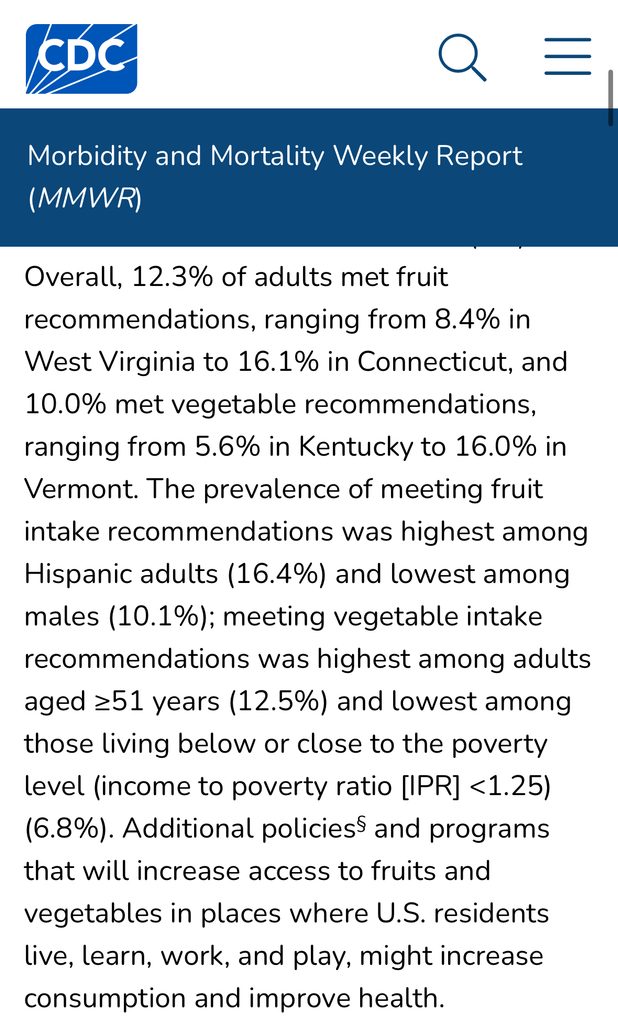
    While Knurick may have personal beliefs that shape her worldview, her scientific advice seems to be influenced mainly by study-backed evidence.

    Through these two examples, I hope I conveyed the usage and helpfulness of the SIFT method in weeding through nutrition misinformation on social media. While a refutation doesn’t always require tons of studies or deep-dives into a creator’s background, if they make certain claims with no sources or even with a source that you think could affect your daily choices, using this method to verify if the advice is correct or not can be extremely beneficial.

    Especially for young people, like myself, who scroll for hours on social media, conflicting information often piles up over time. Making sure you get your information from nutritionists and doctors who understand what the science says, and are able to provide you with the sources is the bare minimum to fact-check rampant misinformation.
  • Blog Assignment #4

    The two companies I chose to research on combatting misinformation are X (Twitter) and TikTok. I chose these two social media stalwarts because I spend the most time on Twitter and have the most familiarity with their system of processing misinformation but I don’t have TikTok and am unfamiliar with the processes they have in place. I wanted to compare and contrast the ways each app/site combats misinformation when social media has a “significantly contributes to the spread of misinformation and has a global reach“, according to this peer-reviewed scholarly article by two Australian researchers.

    Twitter/X

    X’s main form of combatting misinformation is through its Community Notes feature. Originally piloted as birdwatch, owner Elon Musk renamed it as Community Notes following his purchase of the company. The feature, as implied in the name, works to fact-check or provide context to posts based on a number of contributors. According to X’s site, “contributors can leave notes on any post and if enough contributors from different points of view rate that note as helpful, the note will be publicly shown on a post.”

    The algorithm is publicly available on Github, according to X, allowing for anyone to suggest changes or view the process. Community Notes don’t reflect X’s position on the topic; rather, it serves as a way of showing alternate viewpoint’s to the original claim or correcting factual inaccuracies. Oftentimes, additional site are cited so a bystander can access the original source and make informed decisions for themselves.

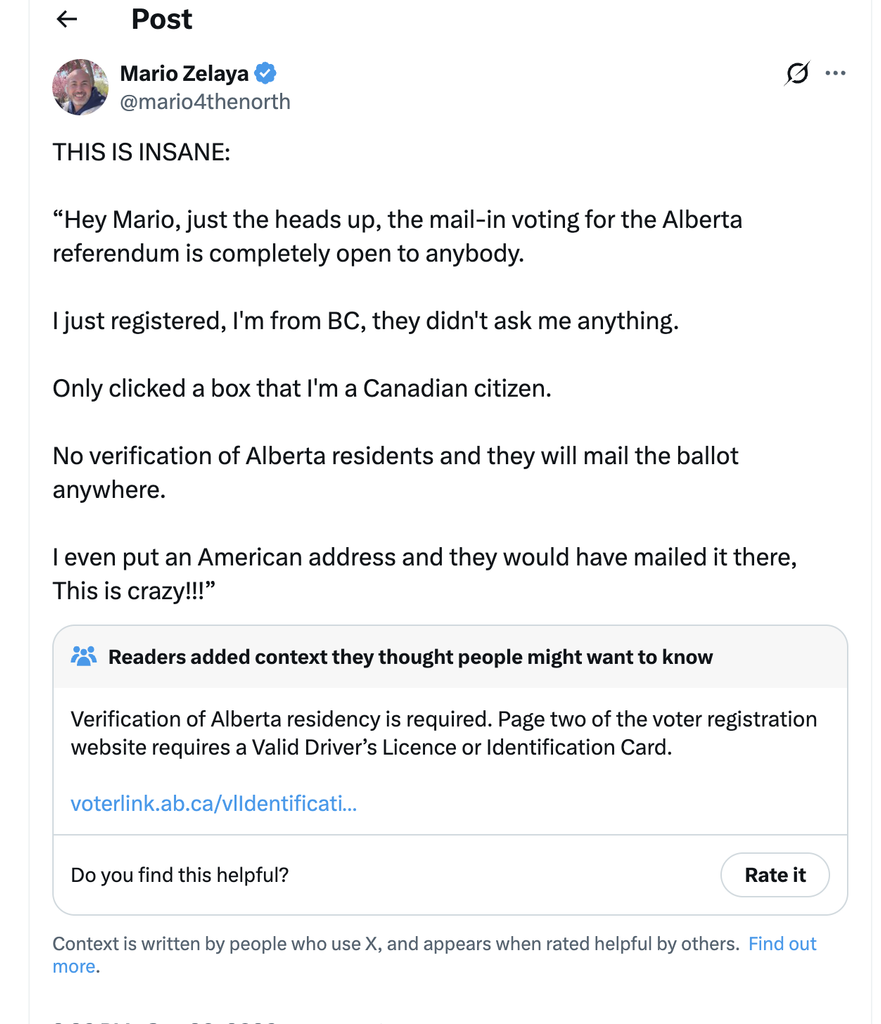
    As seen in the above screenshot, this post falsely stated that verification of Alberta residence isn’t necessary to vote in Alberta and the Community Note refuted that statement and linked viewers to the official site. The post can then be marked helpful or unhelpful by the X community. While a post may receive a Community Note underneath it, the post will not be removed, marked or addressed by X unless it violates the app’s Terms of Service through endangering user’s safety, privacy or being inauthentic.

    X’s Terms of Service has restrictions on a variety of content, including violent content, hateful conduct, child safety, self-harm, and more, with further information on each safety aspect. It’s Privacy policy focuses on not posting other users’ private information (phone number, address, etc), non-consensual nudity and attempting to log into another user’s account. X’s Authenticity policy revolves around misinformation, citing platform manipulation, civic integrity, manipulated media and misleading identities as areas that can potentially disrupt a user’s experience.

    As someone whose usage of the app coincided with the rise in popularity of Community Notes, there are a number of pros and cons with this model. According to this 2025 study by a group of University of Washington researchers, posts with a community note on average “resulted in reductions of 46.1% in reposts, 44.1% in likes, 21.9% in replies, and 13.5% in views after being attached” and “11.6% fewer reposts, 13.3% fewer likes, 6.9% fewer replies, and 5.5% fewer views” across the post’s entire lifespan. This information points to Community Notes generally working in its main capacity, reducing engagement for posts that may or may not be factually correct.

    However, this arXiv study found that 50% of reposts occur in the first five hours after a post is sent and 80% after 16 hours. This presents an issue since, in their compiled data of 285,000, the average time between a misleading tweet being posted and a Community Note being added was 15.5 hours. The paper further noted that only 11.3% of Community Notes are passed and were “Currently Rated Helpful.”

    I think the idea of Community Notes is a good one but I’ve also seen instances where partisan biases affect the correction. While I appreciate X’s transparent, community-based look at correcting misinformation, I also think the site could do a better job at establishing what constitutes misinformation rather than having a vague line being drawn in the sand by the X community.

    TikTok

    TikTok has a completely opposite approach to how it approaches misinformation. TikTok has a guide to countering misinformation, as well as a comprehensive post describing its process. The company uses an automated AI system as its first level of defense to search for keywords or content closely related to misinformation, such as elections or scientific claims. If content is flagged, it can be sent to a human moderator.

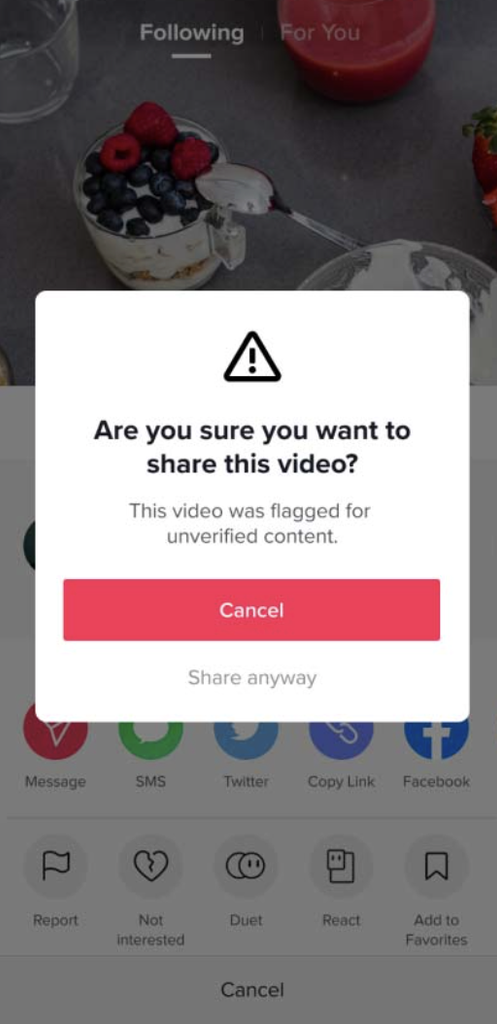
    TikTok states it works with “more than 20 IFCN-accredited fact-checking organizations who assess the accuracy of content on TikTok in over 60 languages and 130 markets across the world.” Similar to X’s Community Notes, these fact-checkers don’t moderate the content but verify its accuracy. If information cannot be verified, TikTok can label it as “unverified” and make the post ineligible to pop up on user’s For You pages, as well as having a warning label indicating the content has been flagged.

    On the integrity side of content, TikTok states it has “dedicated teams and processes for Integrity and Authenticity policies like misinformation, including enhanced training, tooling and expertise.”

    In 2025, TikTok added Footnotes, it’s own version of Community Notes, which allows “eligible members of the TikTok community to provide additional context to any public post on TikTok, except ads.” Although its usage isn’t as prevalent as Community Notes, Footnotes still adds a level of community checks and balances but the issues play out similar to X.

    One aspect I liked about TikTok’s policy was that it maintained it’s relationship with independent fact-checkers. X doesn’t have a professional relationship or program that focuses on fact-checking and I think that would be useful to the site, especially since so much political conversation occurs on it. This New York Times article also noted how TikTok deviated from X in that regard, recalling that “Meta and X drew criticism for reducing investments in fact-checking and moderation.”

    I think TikTok’s policy has improved over the years due to national level scrutiny over misinformation and is closer to what I’d like to happen regularly on social media sites but there’s clear areas to continue its growth with rapid growth in AI-generated content and upcoming political elections. X’s focus on Community Notes is a double-edged sword in my opinion; I think a partnership with independent fact-checkers would be a really beneficial addition to the app.

  • Blog Assignment #3

    Claim: “Under Donald Trump’s leadership, we’ve created one million new jobs. And unlike the last administration where most of the job growth went to illegal aliens, 100% of the job growth in the United States of America is going to American citizens, which is exactly where it belongs.” – Vice President J.D. Vance

    SIFT Method

    S: Vance said this during the 2026 RNC convention held in Dallas ahead of the November midterm elections. This comment caught my eye because I’ve heard Vance make statements similar to this one and the number seemed quite exaggerated. Saying 100% instead of most or many was a vague statement and he also didn’t provide any statistics to back up this claim, although the setting as a rally of sorts might have also played into the lack of depth on the topic. My immediate emotional reaction was that the number was incorrect and I should fact-check whether it was true or not.

    I: J.D. Vance is the vice president of the United States, self-described as a member of the “post-liberal right” and a leading member of the Republican party. On the issue of immigration and Americans in the workforce, Vance recently stated that “if you’re laying off American workers, you shouldn’t be going to the market searching for foreign workers to replace them” and that “the H1B should not exist to replace American workers with low-wage foreigners. It should exist to enrich the American economy.”

    Given this information, it felt to me that his claim on jobs going to American citizens over foreigners reflected his previous position on the issue rather than the data. Going into the factual part of this process, I was focused on three different claims that Vance made: one million new jobs were created under this administration, most of the jobs under the previous administration went to “illegal aliens” and 100% of the new jobs were going to American citizens.

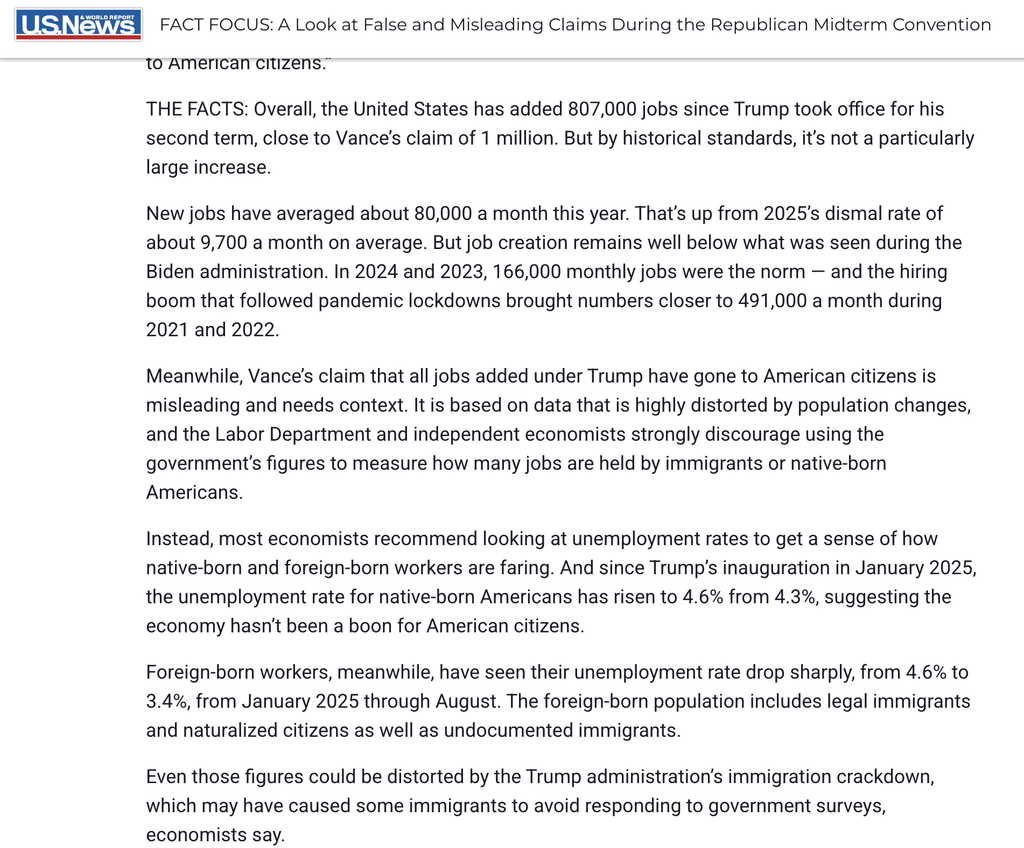
    F: The first article I found was from the Associated Press titled “FACT FOCUS: A Look at False and Misleading Claims During the Republican Midterm Convention”. In it, one of the first claims discussed is this one from Vance. The second article was this one from PBS that had a running fact-check of statements made by Vance during the convention.

    The final one was this one from FactCheck.org that looked over claims made by a number of officials at the convention. All three of them, from the titles and content, seemed to be critical of Vance’s statement, offering much more context on the short nugget of information that the vice president provided. Two of the sites stated that Vance’s overall claim of 1 million new jobs was slightly exaggerated and also pointed to a drop in employment rate for foreign-born workers while the employment rate for American-born workers increased during the same timeframe.

    T: I began with the claim that one million new jobs have been added to the workforce. This claim not only arises from Vance’s statement but this official press release from the White House that states the same thing.

    First, Vance doesn’t make a distinction between private- and public-sector employment. This ambiguity in his statement makes it difficult to properly fact-check what exactly he meant with this statement. The Bureau of Labor Statistics gives the increase in both total nonfarm (private sector + government workers) and private sector employment, with nonfarm employment increasing by 807,000 since Donald Trump took over as president in January 2025 and private sector employment increasing by 1,041,000.

    As stated earlier, Vance is unclear on if he’s only mentioning private-sector jobs in this count. If so, the statement would be considered factual but given the uncertainty, I accepted his statement to include all jobs, for which the nonform employment statistics would work better. The 807,000 increase is close to the number that Vance sites but still sits 200,000 short.

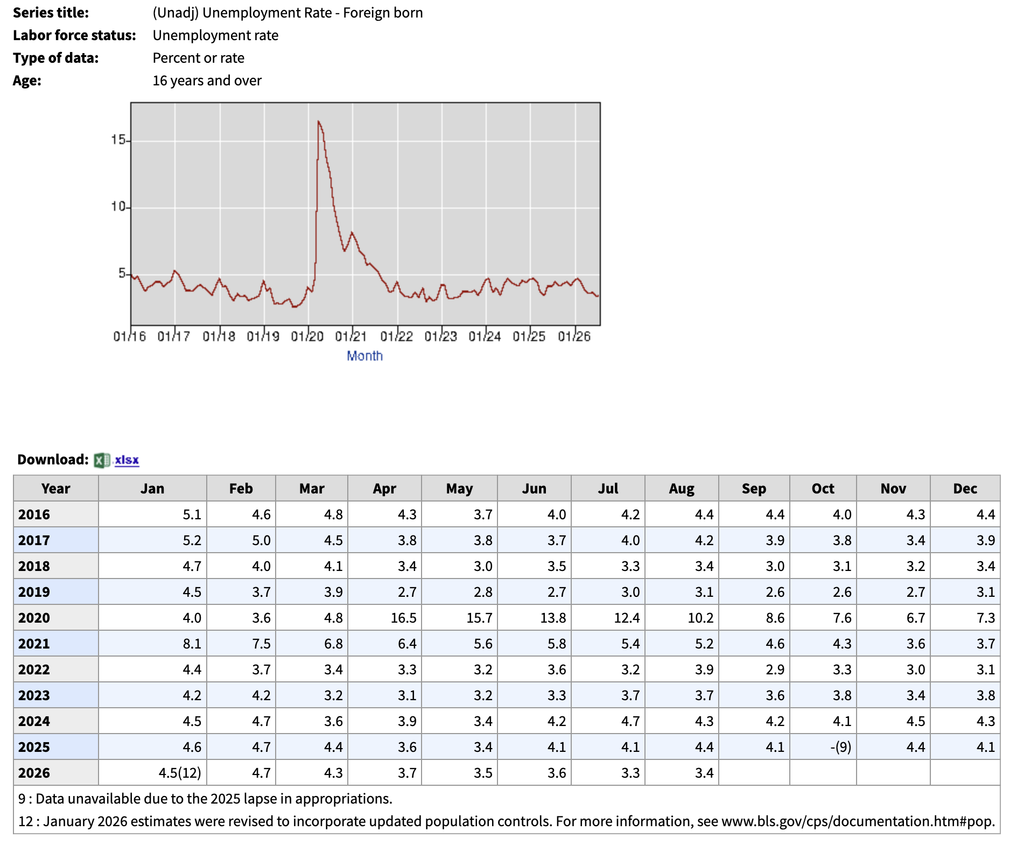
    Vance further claims that 100% of the jobs went to American citizens. While this exact number is hard to track through government records, the BLS noted that the unemployment rate amongst American-born citizens increased from 4.3% in Jan. 2025 to 4.6% in Aug. 2026. During that same timespan, the unemployment rate amongst foreign-born workers decreased from 4.6% to 3.4%. However, we also do have to consider that a number of foreign-born people are also American citizens but it likely goes against Vance’s claim that 100% of the new jobs were going towards American citizens.

  • Blog Assignment #2

    As misinformation rises, I think sites like NewsLiteracy’s RumourGuard, Bad News and Fake It Till You Make It can all be valuable tools when combating false information.

    I began with the RumourGuard tool and found the depth of topics and factors to be very informative. While misinformation can be grouped into one large category, I thought the separation of tactics, including confirmation bias, emotional manipulation, misattribution, false context or conspiratorial thinking, clearly described the ways in which misinformation can be pushed. 

    The way I navigated the site was by first looking at the factors which the site looked at – authenticity, verification by a credible source, evidence, proper context and reasoning. I appreciated how in-depth the site went in providing tutorials and videos on how to research each factor. In particular, I enjoyed the quizzes on how to make sense of data in graphs/charts, the lesson on verifying social media content and learning about logical fallacies. 

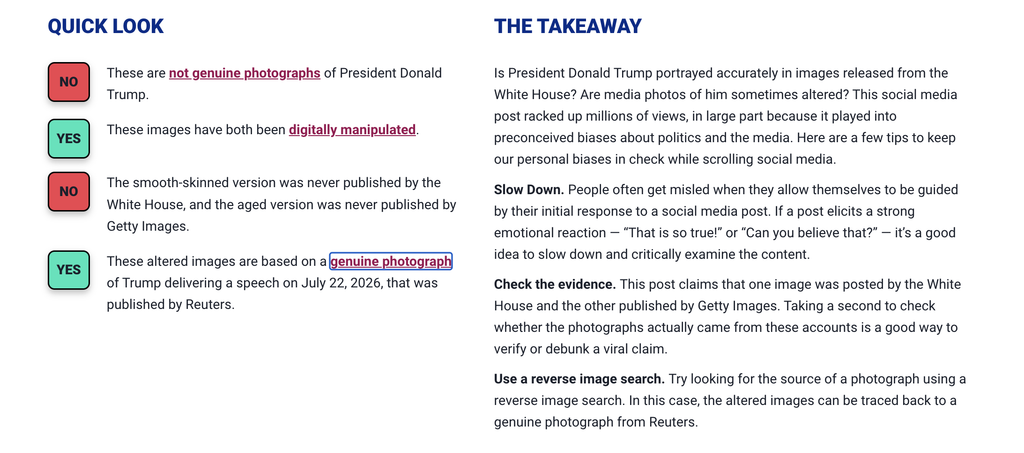
    After looking at the factors, I went through a few of the topics to see how RumourGuard applied these techniques. I began with the topic of confirmation bias and selected the first instance, which showed two altered images of President Donald Trump. Using the five factors, the site determined that both pictures had been altered, and neither had been published by either Getty or the White House as was initially stated in a post on X. 

    As deepfake technology has increased rapidly, its usage in our current political environment is prevalent. This PBS article discussed the Trump Administration’s usage of doctored images, citing an edited picture of civil rights attorney Nekima Levy Armstrong posted by the White House and Homeland Security Secretary Kristi Noem. It also discussed how the current administration uses the idea of jokes or memes to potentially shield themselves from accusations of misinformation.

    I think RumourGuard as a whole was a very interesting site and extremely useful for pointing out misinformed articles. Having never visited the tool before, I think this is a website that I’d share with my family and friends to point them in the right direction on how to properly verify information before sharing it. 

    The game I chose to play was Bad News. This game took the opposite approach to RumourGuard, providing a satirical and interactive experience to show the audience how easily misinformation can be spread. While the posts did feel exaggerated, I felt it did its part in portraying how riled up different social media tactics can get people. 

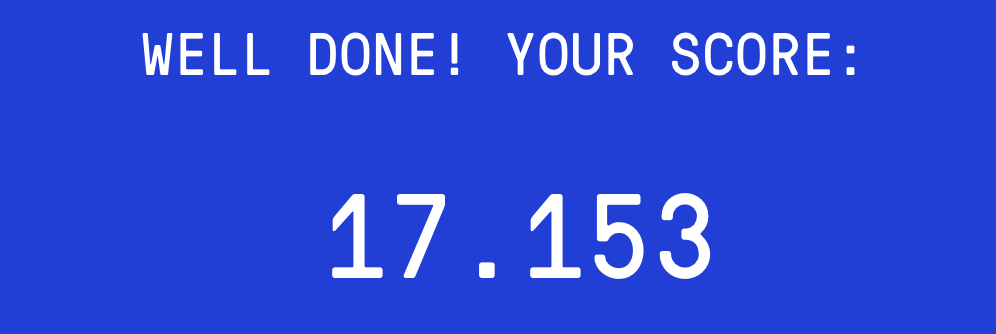
    The game begins by establishing yourself as a somewhat reputable source, and then slowly degrading into posting increasingly polarizing or emotional content. Bad News touches on six different types of misinformation strategies – impersonation, polarization, emotion, conspiracy, discrediting and trolling. The game allows you to post content relating to each one of these strategies and see how citizens respond or react to these articles. At the end, I finished with a follower count of 17, 153.

    I think this tool, while not as informative through videos and real-life examples as RumourGuard, can still be useful, especially when relating to children. The game touches on each tactic and provides some context on how each can be harmful, and also covers why the strategy is misinformation at the end. However, I also think Bad News reflected our current state of social media discourse really well. For example, this article from the New York Times talked about how politicians currently running for positions are often critiqued on their social media postings from years prior. Accounts fighting for one side of the political aisle constantly refer to those tweets as a form of agreement or negative assessment. This pulls from a number of tactics listed in the game, including emotion and polarization.

    Overall, I think all the tools listed were useful in what they intended to do. While I thought RumourGuard provided the best information on misinformation, the interactive game were fun in learning how quickly misinformation can spread. 

  • Blog Assignment #1

    I chose to do my 24-hour media diet on Sunday because I figured I would use my devices more on a weekend rather than a weekday. Throughout the course of the day, I not only learnt how often I was looking at my phone and laptop but also how much information I consumed without a second thought. 

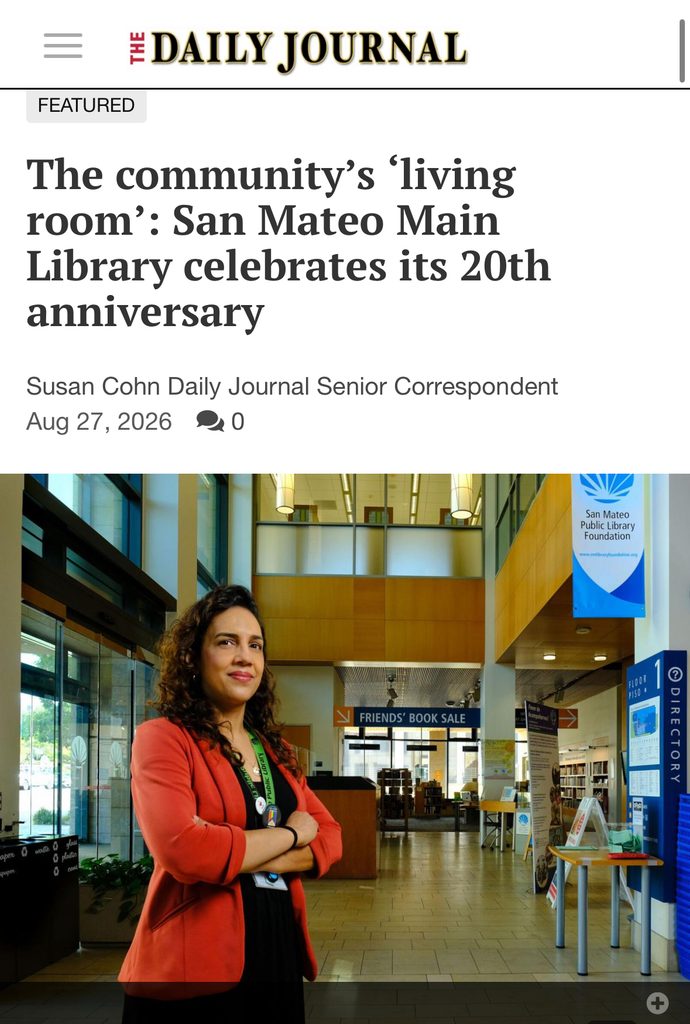
    9:00 a.m. – Wake up and check my phone immediately. I scroll X and Instagram to check if there’s any sports news that occurred in the early morning but nothing in particular. I opened an email from my local newspaper, the San Mateo Daily Journal, recapping some headlines from this past week and read an article about the city’s main library celebrating its 20th anniversary. I interned at the SMDJ and got into the habit of reading more local stories over the summer.

    10:00 a.m. – I quickly scrolled through the New York Times page, reading an article regarding President Donald Trump’s claim that the US has a deal in place for Venezuela’s oil and another quick read about the “Stop Nick Shirley Act” targeting the right-wing YouTuber titled “A MAGA Uproar Ensued After a Bill Was Given a Nick Shirley Nickname.” I didn’t research either story further, although finding other sources highlighting the practical effects of the US-Venezuela oil deal or clicking on the links in the Nick Shirley article would provide a more comprehensive understanding of both topics.

    11:30 a.m. – Scrolling through X again and see this post from NFL insider Adam Schefter concerning Green Bay Packers running back Josh Jacobs being placed on the commissioner exempt list. Read this corresponding article from ESPN providing more context on the NFL’s plans with Jacobs following his arrest earlier this year on charges of misdemeanor battery and the Packers backup plan by trading for Steelers running back Kaleb Johnson.

    12:15 p.m. – Check MLB scores on MLB.com on Google and US Open scores as well for the early matches. 

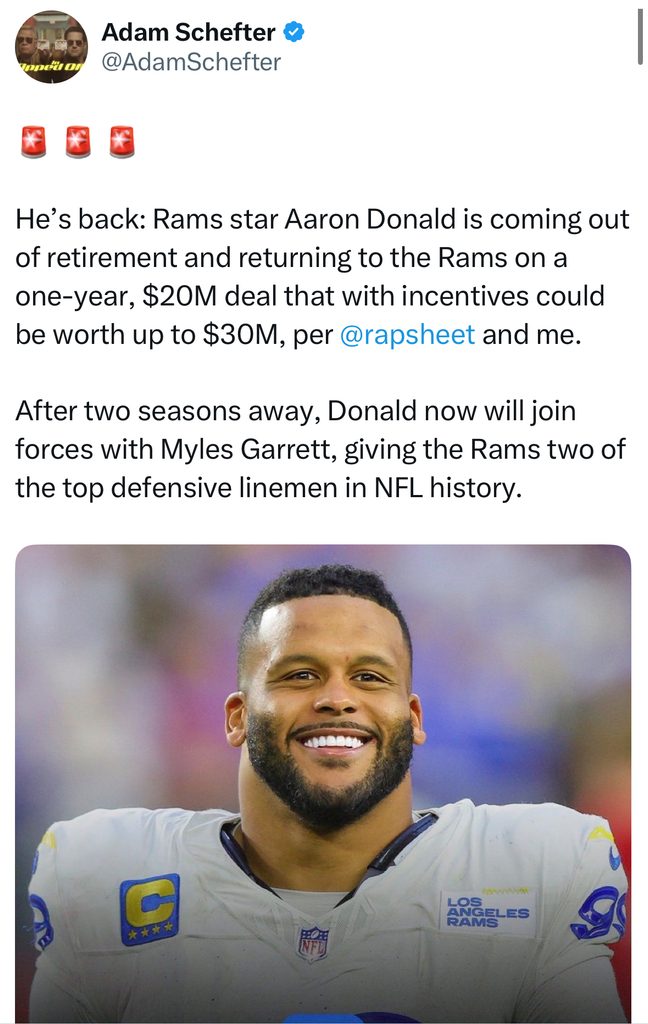
    1:00 p.m. – Get another notification from Schefter about Los Angeles Rams superstar Aaron Donald coming back from retirement to team up with newly acquired Ram and reigning DPOY Myles Garrett. See a plethora of posts and videos surrounding Donald’s return since it’s been rumoured for months now, including this video from Rams practice and quotes from his press conference. 

    4:00 p.m. – Began listening to the Acquired podcast’s episode on Disney while driving, covering the famed company’s tumultuous journey across the decades. Went and did more research after completing around 45 minutes of the podcast and came across this Time article titled “How the Walt Disney Company Made It to 100.” The article, similar to the podcast, focused on Disney’s creative renaissance in the 1980s and 1990s through innovative animations and captivating performances. 

    6:30 p.m. – Scrolling once again on Instagram and X. Lots of fantasy football content, which made sense because I was watching a lot of statistical videos in preparation for my draft. These included posts from creators like Joel Smyth who I follow on both YouTube and Instagram. 

    8:00 p.m. – Went on a run and continued listening to some of the Acquired podcast episode. I also listened to this YouTube video from another fantasy football creator, Flock Fantasy, detailing some underrated picks to add to your team in light of recent news including the potential Jacobs suspension. 

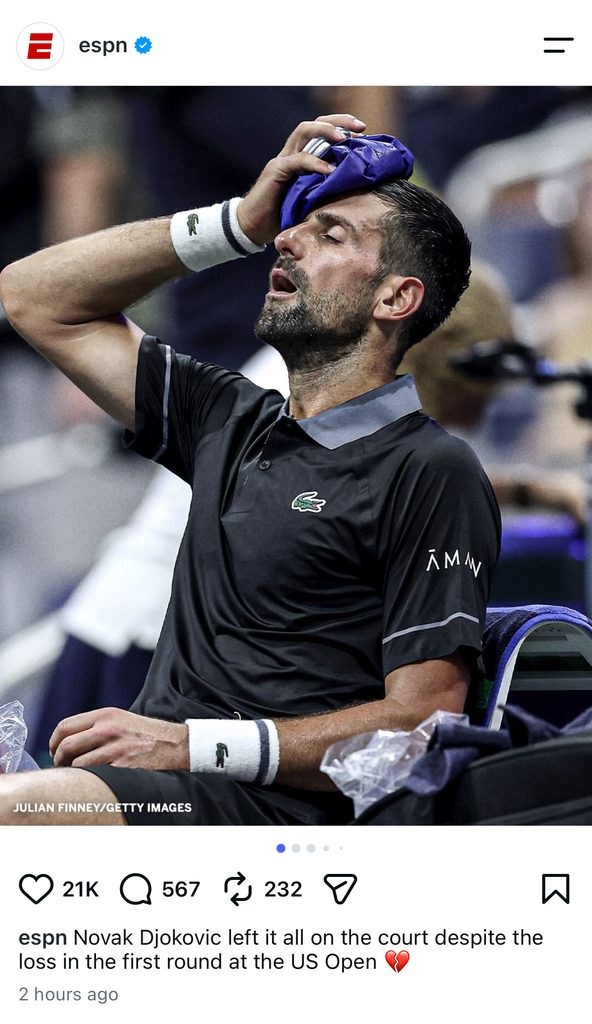
    10:00 p.m. – Watched some of the US Open match highlights, including Novak Djokovic’s shocking first round defeat. The post that stuck with me the most was this collection from ESPN showing the physical and mental struggle Djokovic was going through as he lost in the first round of a Grand Slam for the first time in over 20 years. 

    11:00 p.m. – Worked on MCO 427 blog post for my site before sleeping


    After monitoring my media consumption over the past 24 hours, I wasn’t surprised by the majority of content on my feeds being sports related. It’s the news I react to and connect with more than anything so noticing more sports than politics for me wasn’t anything new.

    A pattern was how much of my news was coming from social media. While I did check the NYT, I didn’t look at the Washington Post or any other major newspaper today nor did I go to major sports websites like ESPN or The Ringer. As we’ve read in modules 1 and 2, social media has widened the reach of the average person so news spreads much quicker on X or Instagram compared to an article.

    I did notice that I’m much more inclined to fact-check or search for additional sources when reading a news article compared to a sports article. This may be due to political biases different sources have compared to legal or news-breaking sports but that’s also an assumption with nothing to back it up. X’s recent addition of community notes has helped give additional perspectives to intentionally inflammatory statements but X and Instagram are still the websites that I’m most wary of when it comes to misinformation.