The two companies I chose to research on combatting misinformation are X (Twitter) and TikTok. I chose these two social media stalwarts because I spend the most time on Twitter and have the most familiarity with their system of processing misinformation but I don’t have TikTok and am unfamiliar with the processes they have in place. I wanted to compare and contrast the ways each app/site combats misinformation when social media has a “significantly contributes to the spread of misinformation and has a global reach“, according to this peer-reviewed scholarly article by two Australian researchers.
Twitter/X
X’s main form of combatting misinformation is through its Community Notes feature. Originally piloted as birdwatch, owner Elon Musk renamed it as Community Notes following his purchase of the company. The feature, as implied in the name, works to fact-check or provide context to posts based on a number of contributors. According to X’s site, “contributors can leave notes on any post and if enough contributors from different points of view rate that note as helpful, the note will be publicly shown on a post.”
The algorithm is publicly available on Github, according to X, allowing for anyone to suggest changes or view the process. Community Notes don’t reflect X’s position on the topic; rather, it serves as a way of showing alternate viewpoint’s to the original claim or correcting factual inaccuracies. Oftentimes, additional site are cited so a bystander can access the original source and make informed decisions for themselves.
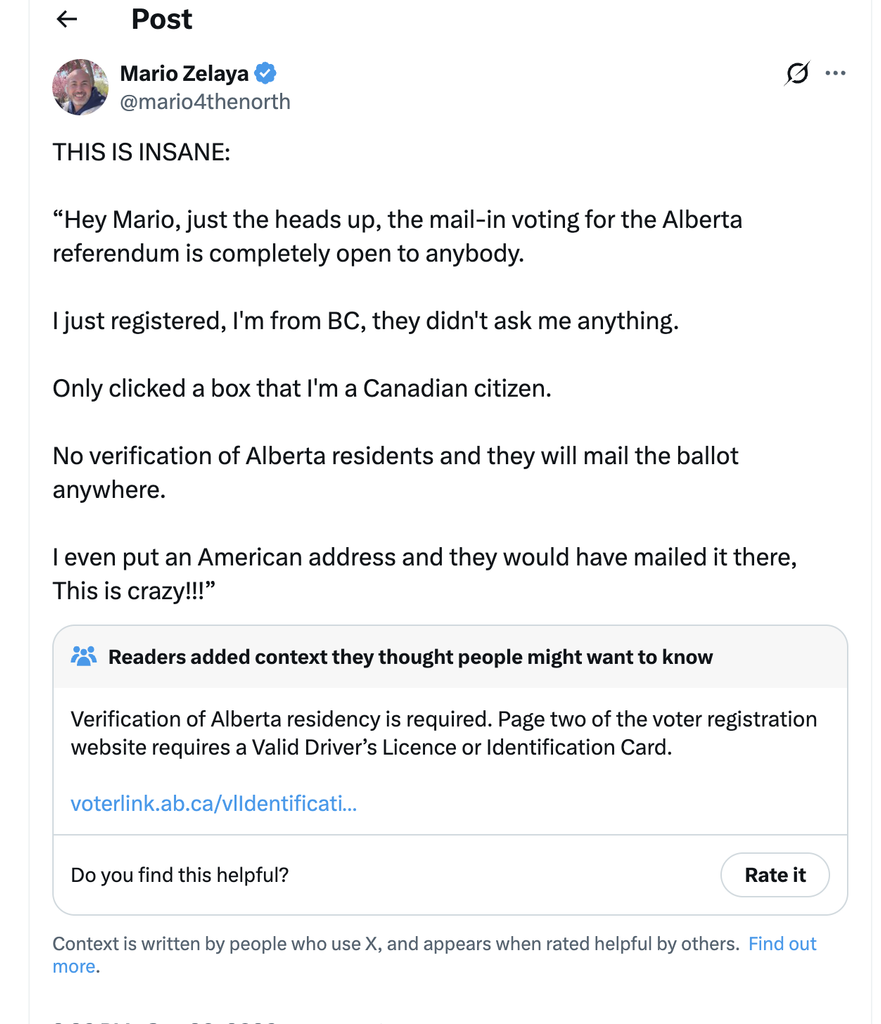
As seen in the above screenshot, this post falsely stated that verification of Alberta residence isn’t necessary to vote in Alberta and the Community Note refuted that statement and linked viewers to the official site. The post can then be marked helpful or unhelpful by the X community. While a post may receive a Community Note underneath it, the post will not be removed, marked or addressed by X unless it violates the app’s Terms of Service through endangering user’s safety, privacy or being inauthentic.
X’s Terms of Service has restrictions on a variety of content, including violent content, hateful conduct, child safety, self-harm, and more, with further information on each safety aspect. It’s Privacy policy focuses on not posting other users’ private information (phone number, address, etc), non-consensual nudity and attempting to log into another user’s account. X’s Authenticity policy revolves around misinformation, citing platform manipulation, civic integrity, manipulated media and misleading identities as areas that can potentially disrupt a user’s experience.
As someone whose usage of the app coincided with the rise in popularity of Community Notes, there are a number of pros and cons with this model. According to this 2025 study by a group of University of Washington researchers, posts with a community note on average “resulted in reductions of 46.1% in reposts, 44.1% in likes, 21.9% in replies, and 13.5% in views after being attached” and “11.6% fewer reposts, 13.3% fewer likes, 6.9% fewer replies, and 5.5% fewer views” across the post’s entire lifespan. This information points to Community Notes generally working in its main capacity, reducing engagement for posts that may or may not be factually correct.
However, this arXiv study found that 50% of reposts occur in the first five hours after a post is sent and 80% after 16 hours. This presents an issue since, in their compiled data of 285,000, the average time between a misleading tweet being posted and a Community Note being added was 15.5 hours. The paper further noted that only 11.3% of Community Notes are passed and were “Currently Rated Helpful.”
I think the idea of Community Notes is a good one but I’ve also seen instances where partisan biases affect the correction. While I appreciate X’s transparent, community-based look at correcting misinformation, I also think the site could do a better job at establishing what constitutes misinformation rather than having a vague line being drawn in the sand by the X community.
TikTok
TikTok has a completely opposite approach to how it approaches misinformation. TikTok has a guide to countering misinformation, as well as a comprehensive post describing its process. The company uses an automated AI system as its first level of defense to search for keywords or content closely related to misinformation, such as elections or scientific claims. If content is flagged, it can be sent to a human moderator.
TikTok states it works with “more than 20 IFCN-accredited fact-checking organizations who assess the accuracy of content on TikTok in over 60 languages and 130 markets across the world.” Similar to X’s Community Notes, these fact-checkers don’t moderate the content but verify its accuracy. If information cannot be verified, TikTok can label it as “unverified” and make the post ineligible to pop up on user’s For You pages, as well as having a warning label indicating the content has been flagged.

On the integrity side of content, TikTok states it has “dedicated teams and processes for Integrity and Authenticity policies like misinformation, including enhanced training, tooling and expertise.”
In 2025, TikTok added Footnotes, it’s own version of Community Notes, which allows “eligible members of the TikTok community to provide additional context to any public post on TikTok, except ads.” Although its usage isn’t as prevalent as Community Notes, Footnotes still adds a level of community checks and balances but the issues play out similar to X.
One aspect I liked about TikTok’s policy was that it maintained it’s relationship with independent fact-checkers. X doesn’t have a professional relationship or program that focuses on fact-checking and I think that would be useful to the site, especially since so much political conversation occurs on it. This New York Times article also noted how TikTok deviated from X in that regard, recalling that “Meta and X drew criticism for reducing investments in fact-checking and moderation.”
I think TikTok’s policy has improved over the years due to national level scrutiny over misinformation and is closer to what I’d like to happen regularly on social media sites but there’s clear areas to continue its growth with rapid growth in AI-generated content and upcoming political elections. X’s focus on Community Notes is a double-edged sword in my opinion; I think a partnership with independent fact-checkers would be a really beneficial addition to the app.
Leave a Reply